
Medfair, Rebuilt.
AI-Clinic Management for Assistive Device Clinics: How and why I rebuilt Medfair, and who it's for.
Aalim Rattansi
September 12, 2026
Software should adapt to people, not the other way around.
That belief is why Medfair exists, and it is why I rebuilt it. I relaunched Medfair with a new design, new foundations, and a much clearer idea of what it needs to be.
Why I built it
Medfair started with my family’s orthotics and prosthetics clinic. The clinical work was excellent. The systems around it were not.
A patient would come in, a clinician would assess them, and then the front desk would spend the afternoon reconstructing a claim application from scratch: the right form for the right device category, the right authorizer, the right signatures, the right funding split. Every claim was rebuilt by hand. Every mistake meant a resubmission, and another few weeks before the clinic was able to reconcile the costs from fitting the patient with the medical device.
None of the tools knew what ADP was. The people in that clinic were spending more time learning systems than they were spending with patients.
This felt like a very solvable problem.
What's in it
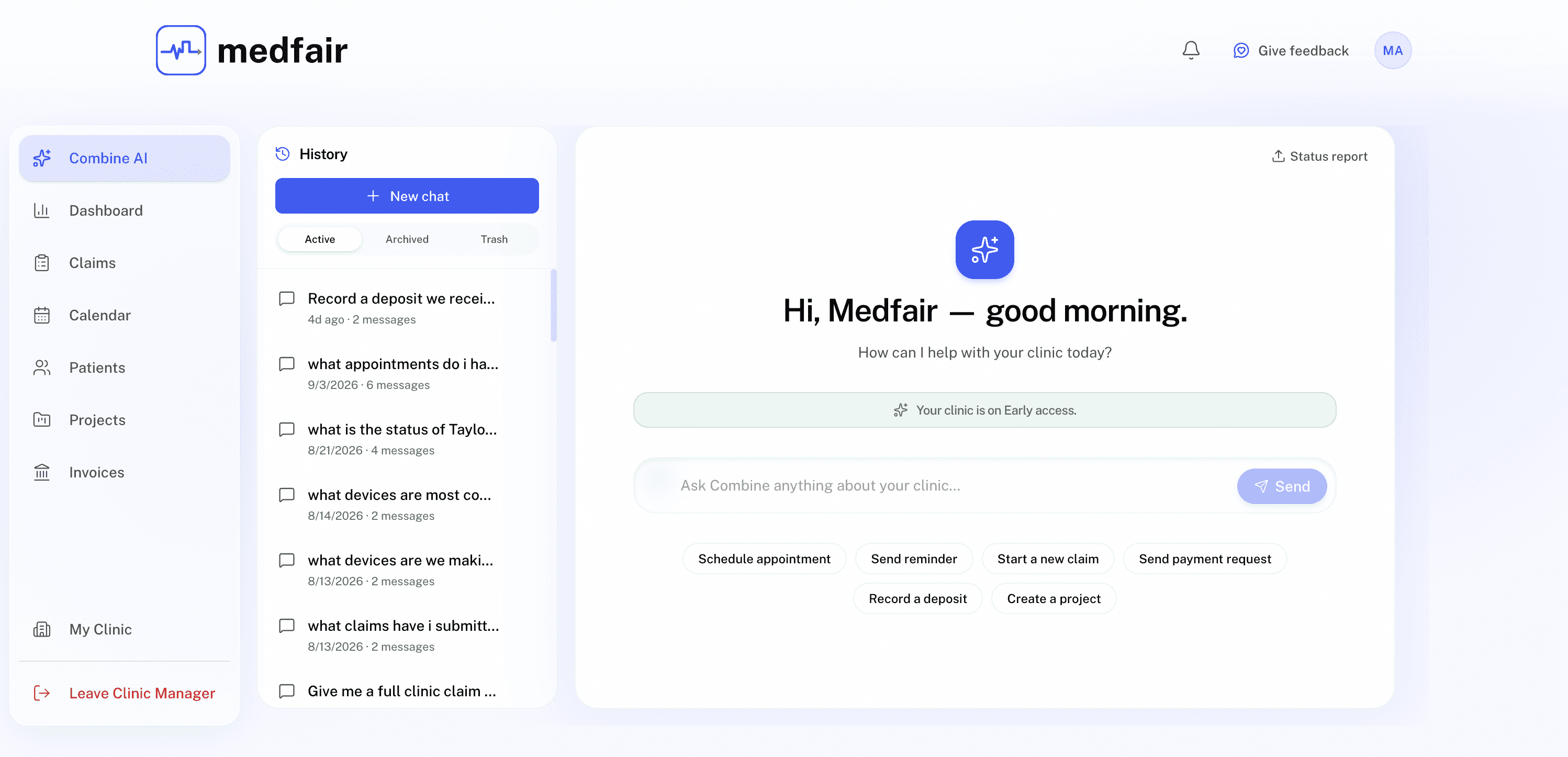
Medfair is built around one idea: you should be able to run your clinic by asking. Every module below exists so that the answer to a question, and the action that follows, can start from you just asking for it.
| Feature | Description |
|---|---|
| Patients | One record per person: contact details, device history, funding eligibility, documents, and notes. The clinician and the receptionist see the same file, and neither has to dig for it. |
| Claims | The centre of Medfair. Claims applications are generated from the patient record, with the correct form and fields for each device category, so nobody retypes information the clinic already has. Every claim has a status you can see at a glance, from draft to submitted to paid. |
| Scheduling | A calendar built for assessment, fitting, and follow-up appointments, so booking a patient already tells you what device they are in for and what paperwork comes next. |
| Projects | Custom devices do not happen in one visit. Projects follow a device from prescription through fabrication, fitting, and delivery, so nothing stalls because a follow-up was forgotten. |
| Medfair Pay | Send patient invoices, take payments, and keep the ADP portion and the patient portion separate. No more reconciling in another system at month end. |
| Combine AI | Ask a question in plain English, about a patient, a claim, a schedule, or your revenue, and get a real answer from your clinic's own data. When the answer calls for action, Combine AI can draft the note, prepare the claim, or send the message. It works in the background, like a capable teammate, not another window to manage. |
"We do not believe AI should replace the human being. We believe it should reduce the technical barriers that separate people from meaningful work."
That line is from our Ethics Statement on AI, and it is the standard Combine AI is held to.
Who I hope it helps
Medfair is for the clinics that handle assistive devices: orthotics, prosthetics, mobility, and hearing. More specifically, it is for the people inside those clinics who carry the administrative weight of getting devices funded. The admin who knows every claim form by heart. The clinic manager chasing outstanding claims. The clinician who would rather be listening to a patient than filling in a field.
Most practice management software treats claims as an afterthought, because it was built for another kind of clinic and adapted later. We wanted to build one where the claims process was designed first.
Medfair chooses people over complexity. Understanding over interfaces. Refocusing your practice to the services you provide, not the tools you use.
If that sounds like yours, I want to hear from you. Try Medfair at medfair.ca, or schedule a demo. This product was built by listening to clinics, and that is how it will keep getting better.
Thank you.