
AI and sensors are turning rehabilitation into a continuous, data-driven practice
Robotics, smartphone motion analysis and predictive tools are extending what clinicians can see and support between appointments. The opportunity is not to automate care, but to make clinical judgment better informed.
Aalim Rattansi
September 23, 2026
Rehabilitation has always depended on what happens between appointments.
A clinician may get a focused window to assess movement, guide an exercise or adjust a device. Recovery unfolds across the rest of the week: every step, repetition, hesitation, compensation and small gain that happens at home.
For most of rehabilitation’s history, much of that work has been difficult to see. Clinicians have relied on periodic assessments, patient recall and what they can observe in the treatment room.
That gap is beginning to narrow.
Robotic rehabilitation systems can help patients complete more supported repetitions in the clinic. Smartphones and wearable sensors can capture movement outside it. Artificial intelligence can help organize the resulting data, identify patterns and flag when a plan may need another look.
Together, these tools point toward a different model of rehabilitation: not a series of isolated encounters, but a continuous feedback loop between patient, clinician and care plan.
Key takeaways
- Robotic rehabilitation can increase the dose of practice. The most consistent evidence, for arm recovery after stroke, suggests much of the benefit comes from that extra task-specific practice.
- Smartphones can make movement measurable outside the clinic. A 2026 study measured joint angles from handheld phone video to within three degrees of a multi-camera motion capture system, including in lower-limb prosthesis users.
- Accuracy depends on the tool. Results vary by app, joint and patient group, and models trained mostly on able-bodied people can struggle to track a prosthetic limb.
- AI can support clinical decisions by finding patterns in progress data and estimating likely outcomes. It should not replace professional judgment.
- Continuous rehabilitation creates operational work. Consent, privacy, documentation, communication and billing all need to keep pace with the clinical data.
- The goal is not more data for its own sake. It is earlier insight, more responsive care and more time for the human parts of rehabilitation.
Robotic rehabilitation can increase the dose of practice
Recovery often requires repetition. The challenge is delivering enough high-quality practice without exhausting the patient or placing unnecessary physical strain on the therapist.
That is where rehabilitation robotics can help.
During National Rehabilitation Week in September 2026, Allied Services’ John Heinz Institute of Rehabilitation Medicine in Pennsylvania introduced Rise&Walk, a three-in-one robotic rehabilitation system for adult and pediatric patients with neurological conditions, injuries, disabilities and mobility challenges. The system combines seated exercise, standing balance and support, and robotic-assisted gait training, including backward walking. Staff said patients can work for longer before they tire, and highlighted how the system brings the arms into a coordinated swing during gait retraining.
One installation does not establish how every patient will respond, and the wider research gives a more measured picture. A 2026 umbrella review of AI and technology in rehabilitation found that the most reproducible benefit was improved upper-limb activity after stroke, from technology-assisted training, including robotics, that increases task-specific practice. When studies matched the amount of practice and blinded their assessors, effects on impairment and independence were inconsistent.
In other words, much of the value is in the dose. A robot can provide repeatable assistance, body-weight support or resistance. It can help a patient practise a movement many times while a therapist observes quality, adjusts difficulty and focuses on safety. It can also record what happened during the session: how much assistance was needed, how many repetitions were completed and how performance changed.
The machine does not decide what matters to the patient. It does not interpret fear, fatigue or confidence. Its value is in extending what a skilled clinician can safely deliver and measure.
The smartphone is becoming a movement sensor
The more consequential shift may be happening with a device most patients already own.
Modern smartphones contain cameras, accelerometers and gyroscopes that can measure aspects of motion. With the right software, a phone can estimate joint angles, count exercise repetitions and capture functional tasks such as walking or rising from a chair.
Measuring range of motion at home
In a 2024 study from Singapore, 30 people recovering from a total knee replacement measured their own knee range of motion with an accelerometer-based smartphone app. All of them could do it, their readings were highly consistent between sessions, and their results differed from a physiotherapist’s goniometer measurements by an average of 2.2 degrees for extension and 4.5 degrees for flexion.
Camera-based tools are improving too. A validation study in people with knee osteoarthritis, published in Physiotherapy, found that a smartphone-based, single-camera markerless motion capture platform measured knee flexion, extension and range of motion validly and reliably against a laboratory 3D motion capture system. It was a small study, with 15 patients.
Smartphone gait analysis from handheld video
Research is also moving beyond single joints to the whole body. A 2026 study in npj Digital Medicine, by researchers at Chicago’s Shirley Ryan AbilityLab and Northwestern University, introduced the Portable Biomechanics Laboratory: software that fits biomechanical models to ordinary handheld smartphone video.
Checked against a multi-camera motion capture system across more than 15 hours of recordings, it measured joint angles to within three degrees in people with neurological injuries, lower-limb prosthesis users, pediatric inpatients and controls. Across 1,021 videos recorded in routine clinical care, it produced reliable gait measures and picked up clinically relevant differences in how people moved.
What this means for prosthetic and orthotic care
That participant list matters to prosthetic and orthotic clinics. Watching a patient walk is part of fitting and aligning many prostheses and orthoses, yet, as the Chicago researchers note, there are few tools for measuring gait quantitatively in the clinic.
The evidence here is specific. The npj Digital Medicine study included 40 lower-limb prosthesis users in its validation group, and its gait-quality score was significantly lower for people with transfemoral amputations than for those with transtibial amputations. An earlier study by the same group validated in-clinic video gait analysis for prosthesis users seen in therapy and outpatient clinics: estimated walking speed was similar to timed 10-metre walks, and cadence and foot-contact times closely mirrored wearable sensors.
That earlier study also carried a warning. A pose-estimation model trained largely on able-bodied people struggled to locate prosthetic joints, particularly for people with more proximal or bilateral amputations. The analysis worked for them only after the researchers trained a prosthesis-specific joint detector.
Accuracy depends on the tool
None of this makes every phone app a clinical instrument.
A 2026 study in Sensors tested a smartphone sensor-based range-of-motion app against a universal goniometer in 30 healthy young adults, then compared the app’s in-person readings with remote ones. Agreement with the goniometer was limited for most lower-limb movements: ankle plantarflexion agreed best, while hip and knee readings agreed poorly. The app’s in-person and remote hip and knee readings were reasonably consistent with each other, so the authors saw it as a way to track change over time in telerehabilitation, not as a substitute for in-person goniometry.
Phone placement, lighting, movement plane, patient instructions and the underlying model can all affect results. The 2026 umbrella review also found that computer-vision movement assessment tends to lose accuracy between development and real-world deployment.
For clinics, the question is not simply whether a tool uses a phone. It is whether that specific tool has been validated for the patient, the movement and the decision it is meant to support.
AI can turn rehabilitation data into better questions
Sensors can create a stream of numbers. Clinicians still need to decide which changes are meaningful.
This is where AI may be most useful: not as an autonomous therapist, but as a layer that helps interpret patterns over time.
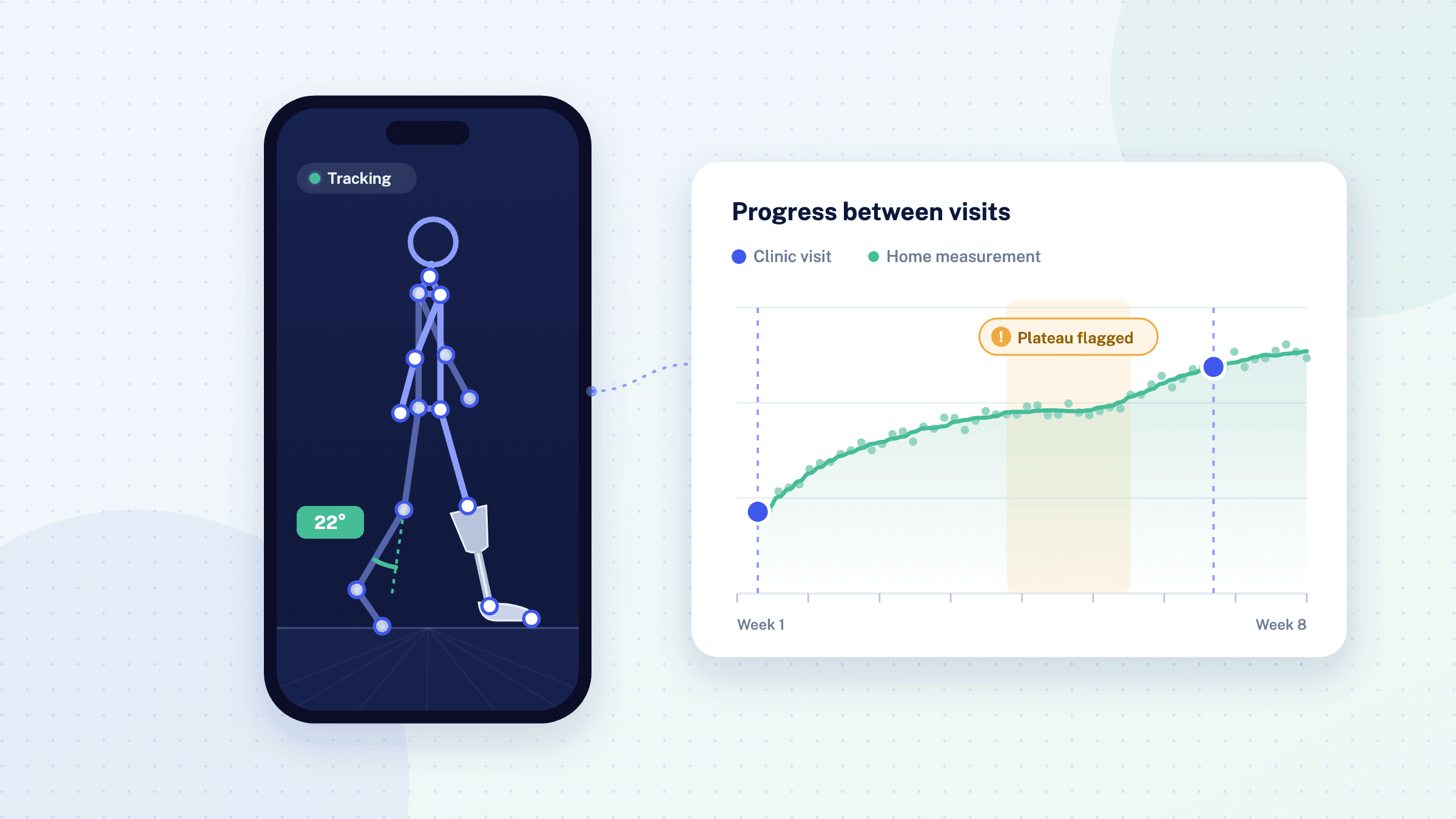
A model might notice that range of motion has plateaued, that asymmetry between the left and right sides is growing or that a patient is completing fewer home exercises. It might compare the current trajectory with similar cases, estimate the likelihood of a functional outcome or prompt a clinician to reassess the plan.
Early clinical studies suggest this kind of decision support can help. In a 2025 prospective pilot in the Netherlands, machine-learning prognostic profiles were produced for 17 patients starting an interdisciplinary program for chronic musculoskeletal pain. The profiles were consistent with clinicians’ own assessments for 14 of the 17 patients, and clinicians found them helpful in 15 of 17 initial assessments, where they supported shared decision-making and individualized treatment planning.
Canadian researchers are exploring similar ideas. In 2024, St. Joseph’s Health Care London described a study by researchers at its Parkwood Institute that is using machine learning to categorize how physical therapists describe rehabilitation activities for people with spinal cord injuries, with the aim of learning which activities are linked to the best outcomes.
Prediction is not certainty. A recovery estimate is shaped by the population and data used to build the model. The 2026 umbrella review found that reporting on rehabilitation prediction models often falls short of current AI standards, that the research skews toward high-income settings and that performance for different patient subgroups is seldom reported. A model can also miss what is obvious in conversation but absent from a dataset: a patient’s goals, home environment, pain experience, health literacy or access to support.
The safest role for AI is to turn measurements into better questions:
- Is the patient progressing as expected?
- Is a compensation pattern emerging?
- Has adherence changed?
- Does the plan, or the device, need to be adjusted?
- Is an in-person reassessment needed?
Those are prompts for clinical judgment, not substitutes for it.
What continuous rehabilitation looks like in practice
In an episodic model, assessment and adjustment happen mainly during scheduled visits.
In a continuous model, the same clinical cycle extends between them:
- Establish a baseline. The clinician combines a hands-on assessment with validated functional measures.
- Set a plan. The patient receives exercises, device instructions and goals suited to their condition and circumstances.
- Observe between visits. A phone, wearable or connected device records selected movements, symptoms or activity.
- Surface meaningful change. Software summarizes trends and alerts the clinician when agreed thresholds are crossed.
- Respond. The clinician reinforces, modifies or pauses the plan and decides whether the patient needs to come in.
- Document the decision. The relevant result and the clinical response become part of the patient record.
This does not mean watching every movement or flooding a dashboard with data. Remote monitoring works only when the clinic is deliberate about what it measures, why it matters and who is responsible for responding.
More data creates new responsibilities
The technology may be new. The core obligations are familiar.
Clinical validity. A tool should be accurate enough for its intended use. Tracking exercise adherence is not the same as informing a diagnostic or treatment decision.
Consent and privacy. Movement video and sensor data can be sensitive health information. Patients should understand what is collected, where it is stored, who can access it and how long it is kept. In Canada, that means meeting the privacy law that applies to your clinic, such as Ontario’s PHIPA or the federal PIPEDA, and knowing where a vendor keeps the data.
Equity and accessibility. Not every patient has a current smartphone, reliable internet, space to record movement or confidence using an app. The 2026 umbrella review found that usability, adherence and equity are under-measured, particularly for care delivered at home. Remote measurement should expand access, not become a condition of good care.
Human oversight. Alerts need owners. Clinics need clear rules for what is reviewed, by whom, within what timeframe, and what patients should do if their condition changes urgently.
Workflow integration. Data that sits in a separate portal can create another inbox rather than better care. Useful information needs to reach the record, the responsible clinician and the next decision without extra copying and searching.
More data is not automatically more insight. Without these foundations, it can become more noise, more liability and more work.
Continuous care needs continuous operations
As rehabilitation becomes more measurable between visits, the administrative side of care cannot remain a collection of disconnected tasks.
A remote check-in may trigger a message, a revised home program, a device adjustment, a new appointment, a progress note or a billing action. If each step lives in a different system, the clinical benefit can be cancelled out by clerical burden.
Clinics will need operations that connect scheduling, communication, documentation, consent and billing to the same care journey. They will also need a clear record of what was measured, what the clinician decided and what happened next.
This is where the direction of rehabilitation meets the reason Medfair exists.
We believe technology should reduce the barriers between people and meaningful care. AI should not replace a clinician’s judgment or the patient’s voice. It should help clinics spend less time navigating systems and more time understanding the person in front of them. That is the principle behind our ethics statement on AI, and it is why Medfair keeps patient files, scheduling, claims and billing in one system.
The future of rehabilitation is not clinician versus machine.
It is a clinician with a clearer view of recovery, and a patient whose progress does not disappear between appointments.
Frequently asked questions
How is AI used in rehabilitation?
AI is used to estimate joint angles and gait measures from video, summarize progress and exercise adherence between visits, and predict likely outcomes so clinicians can personalize treatment plans. Most of these uses are still being validated, and results vary by tool and patient group.
Can a smartphone measure range of motion accurately?
Some apps can, for some joints. In one study, people recovering from knee replacement measured their own knee range of motion with a smartphone app, and their results differed from a physiotherapist’s goniometer by an average of 2.2 to 4.5 degrees. Another app agreed poorly with a goniometer at the hip and knee. Accuracy depends on the app, the joint and how the measurement is taken.
What is smartphone gait analysis?
Smartphone gait analysis uses ordinary phone video, processed by computer-vision and biomechanical models, to measure how a person walks: joint angles, cadence, walking speed and overall gait quality. In a 2026 study, one platform measured joint angles to within three degrees of a multi-camera motion capture system across several patient groups, including lower-limb prosthesis users.
Does smartphone gait analysis work for prosthesis users?
It can, with the right model. Researchers validated in-clinic video gait analysis for prosthesis users, with walking speed similar to timed walk tests and cadence and foot-contact timing closely matching wearable sensors. They also found that a model trained mostly on able-bodied people struggled to locate prosthetic joints, especially for people with more proximal or bilateral amputations, until they trained a prosthesis-specific detector.
Will AI replace rehabilitation clinicians?
Current evidence does not support using it that way. A 2026 umbrella review of AI in rehabilitation recommended an adjunct-first approach: adding AI to clinical care, and only where it measurably improves outcomes that matter to patients. Assessment, treatment decisions and the relationship with the patient remain clinical work.
What privacy rules apply to remote rehabilitation data in Canada?
Health information collected in the course of care is protected by privacy law, such as Ontario’s Personal Health Information Protection Act (PHIPA) or the federal Personal Information Protection and Electronic Documents Act (PIPEDA), depending on where and how a clinic operates. Before adopting a remote-monitoring tool, confirm what it collects, where the data is stored, who can access it and how long it is kept.
Sources
- Allied Services introduces new robotic rehabilitation system during National Rehabilitation Week — Times Leader, 2026
- Artificial intelligence in rehabilitation: a review of clinical effectiveness, real-world performance, safety, and equity across modalities and settings — Frontiers in Digital Health, 2026
- Feasibility, reliability and validity of self-measurement of knee range-of-motion using an accelerometer-based smartphone application by patients with total knee arthroplasty — PLOS ONE, 2024
- Exploring the validity of smartphone based single camera markerless motion capture technology to quantify knee range of motion in patients with knee osteoarthritis — Physiotherapy, 2026
- Portable biomechanics laboratory enables clinically accessible movement analysis from a handheld smartphone — npj Digital Medicine, 2026
- Validation of portable in-clinic video-based gait analysis for prosthesis users — Scientific Reports, 2024
- Criterion validity and inter-method reliability of a smartphone sensor-based application for lower-limb range of motion: in-person vs. tele-assessment — Sensors, 2026
- Machine learning clinical decision support for interdisciplinary multimodal chronic musculoskeletal pain treatment — JMIR Rehabilitation and Assistive Technologies, 2025
- Artificial intelligence making strides into rehab — St. Joseph’s Health Care London, 2024