
Alberta Assistive Device Funding Guide: AADL, Prosthetics, Orthotics, Hearing Aids and Mobility Equipment
How funding works for prosthetics, orthotics, hearing aids and mobility equipment in Alberta: what AADL pays, who is exempt from the cost-share, and which programs pay first.
Aalim Rattansi
October 12, 2026
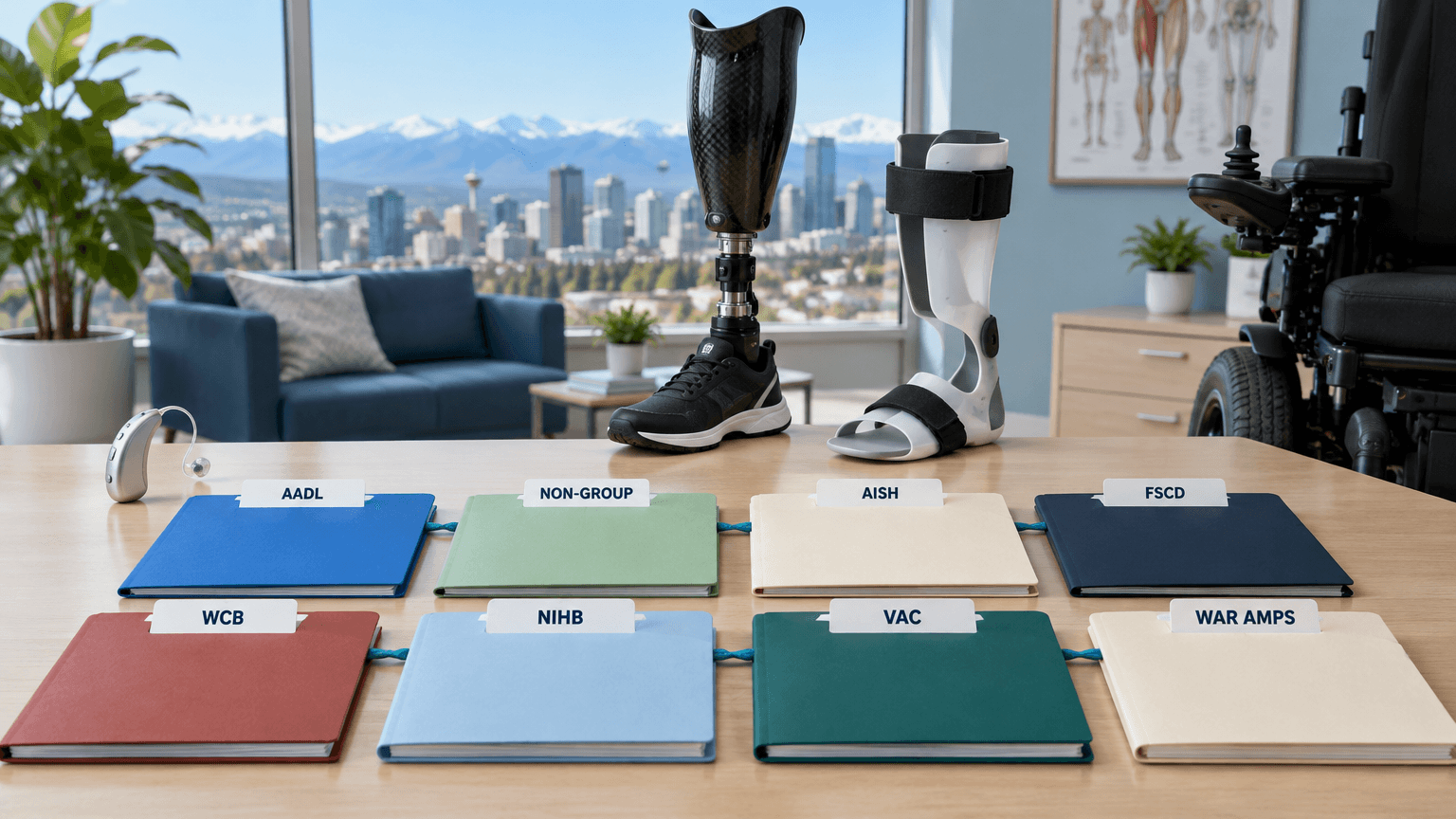
A prosthetic limb, custom brace, hearing aid or wheelchair can decide whether someone gets back to work, school or living on their own. In Alberta, paying for that device often involves more than one program.
The main provincial program, Alberta Aids to Daily Living (AADL), is not income-tested, but it has a cost-share, price maximums and replacement limits. Federal programs, the Workers' Compensation Board, disability programs and charities can each cover a different part. And since October 1, 2026, a new law changes who pays first for people with Alberta Blue Cross Non-Group or Coverage for Seniors.
This guide explains the main options, especially for people with limited income or no private insurance.
Current as of October 7, 2026. Funding rules and amounts can change. Confirm eligibility and obtain approval before ordering a device.
Key takeaways
- AADL is the starting point. It funds basic medical equipment for Albertans with a long-term or terminal condition. There is no income test.
- The cost-share is 25%, capped at $500 per family per benefit year (July 1 to June 30). Upgrades and costs above AADL's maximum price are extra and do not count toward the cap.
- Many people pay no cost-share. Low-income Albertans and people on AISH, ADAP or Income Support can be exempt. Seniors 65 and older pay none on prosthetic and orthotic benefits.
- AADL does not cover foot orthotics. It does fund braces, prosthetic limbs, hearing aids, wheelchairs and walking aids, within program limits.
- Another payer may come first. WCB, Veterans Affairs Canada, Non-Insured Health Benefits and full private coverage come before AADL. Under Bill 11, Non-Group Coverage and Coverage for Seniors now pay last.
- Get authorized before you buy. AADL does not reimburse equipment bought before assessment and authorization.
How does Alberta Aids to Daily Living (AADL) work?
Alberta Aids to Daily Living helps Albertans with long-term disabilities, chronic illness or terminal illness pay for basic medical equipment and supplies. Claims are processed through Alberta Blue Cross.
To qualify, you need a valid Alberta Health Care Insurance Plan card and a condition lasting six months or longer, or a terminal illness. You must also be assessed and authorized by an AADL-approved health professional, called an authorizer. There are no income requirements.
For orthotics, prosthetics and hearing aids, the assessment is done by a professional at an AADL-approved specialty vendor. For most other equipment, an authorizer such as an occupational therapist, physiotherapist or registered nurse does it. Your local hospital, health centre or HealthLink (811) can help you find one.
You then get the item from an AADL-approved vendor.
Apply before buying. AADL does not reimburse people who buy their own equipment or supplies before they are assessed and authorized.
How much does AADL cover in Alberta?
AADL pays for an approved benefit up to the maximum price on its product list. Under the AADL cost-share policy:
- Clients pay 25% of the cost of program benefits.
- The client share is capped at $500 per family per benefit year (July 1 to June 30).
- Respiratory benefits have no cost-share.
- Seniors 65 and older pay no cost-share on prosthetic, orthotic, breast prosthesis or ocular prosthesis benefits.
The cap does not cover everything. Upgrades and anything above AADL's maximum price are paid by the client and do not count toward the $500. Ask the vendor for an itemized estimate first; vendors can run a predetermination through Alberta Blue Cross that shows the exact cost-share owing.
Who is exempt from the AADL cost-share?
You can apply for an exemption if your taxable income (line 26000 of your most recent tax return) is at or below these limits:
| Household | Taxable income limit |
|---|---|
| Single person | $20,970 |
| Family with no children | $33,240 |
| Family with children | $39,250 |
People on Income Support, AISH, the Alberta Disability Assistance Program (ADAP) or the Alberta Adult Health Benefit should contact AADL to confirm their exemption. If your income has recently dropped, ask about a temporary exemption. If the cost-share would cause hardship, you can appeal.
What changed for Alberta Blue Cross coverage on October 1, 2026?
The benefit-plan changes in Bill 11, the Health Statutes Amendment Act, 2025 (No. 2), took effect on October 1, 2026. They made two government-sponsored supplementary plans, Non-Group Coverage and Coverage for Seniors, the payor of last resort.
According to the Bill 11 implementation reference guide:
- Private, employer-sponsored, retiree and federal plans must pay first.
- Claims submitted in the wrong order "will be deemed ineligible."
- The government plan can then cover your remaining co-payment, up to what it would have paid as first payer.
This matters for orthotics and prosthetics because of Non-Group Coverage, the premium-based plan for Albertans under 65. It covers up to 25% of the maximum allowable amount for listed items: artificial eyes, prosthetic devices and braces needed for six months or longer. A physician's written order is required. Myoelectric prostheses and foot orthotics are excluded.
Non-Group has a $50 annual deductible, and coverage generally starts on the first day of the fourth month after your application is received. You cannot sign up the week you need a brace.
AADL is not on the reference guide's list of affected plans. It has its own long-standing rule: if private insurance covers 100% of an item, you are not eligible for the same item through AADL until that coverage is ruled out or used up.
Tell your clinic about every plan you have. Workplace, retiree, spousal and federal coverage should all be on file so claims are billed in the right order.
Alberta prosthetic limb funding
AADL funds prosthetic limbs under its orthotic and prosthetic manual and product lists. The key rules:
- A prescription is required. It must come from an Alberta physician or nurse practitioner and is current for three months.
- The provider must be AADL-approved.
- One device per limb at a time. AADL funds the primary device only, not backups or limbs used only for work or recreation.
- Replacement every two years, if needed. Exceptions include myoelectric prostheses, microprocessor knees and soft supplies.
- Some early replacements are allowed. Children can get one early replacement within two years as they grow. People with a new lower-limb amputation can get one early socket replacement.
- Repairs are limited. AADL funds no repairs or modifications in the first 90 days and does not replace lost, stolen or damaged devices.
Microprocessor knees are funded as a $6,000 grant, once every five years, for clients functioning at Functional Level 3 or higher. After that, AADL will not fund replacement, repair or maintenance of any prosthetic or microprocessor knee on that side for five years.
Other prosthetic funding programs
The War Amps Child Amputee Program (CHAMP) serves children in Canada under 18. It pays the part of an everyday artificial limb, including adjustments and repairs, that provincial and private plans do not cover. It covers the full cost of recreational limbs, such as swimming or biking legs.
The War Amps Adult Amputee Program helps enrolled amputees 18 and older with artificial limb costs. You must use provincial and private or workplace coverage first.
Alberta orthotic funding
AADL funds orthotic braces, including spinal, upper-limb, lower-limb and clubfoot orthoses. The prescription, specialty-supplier and two-year replacement rules are the same as for prostheses, though knee orthoses and non-rigid supports have their own limits. Braces needed only before or after surgery are not AADL benefits.
AADL does not cover foot orthotics. AADL does fund custom-made footwear and therapeutic shoes with custom modifications.
When AADL does not apply, other options include:
- Private or workplace insurance. This is often the main payer for foot orthotics.
- AISH personal benefits. These can help with arch supports, foot orthotics, splints and braces when no other program pays. An asset limit and a needs test apply. See what AISH covers.
- Non-Group Coverage. It pays up to 25% of the maximum allowable amount for listed braces needed for six months or longer, but not foot orthotics.
Alberta hearing aid funding
AADL hearing aid funding depends on age and income. Under the AADL hearing aid benefit and the amplification manual:
| Who | What AADL may fund |
|---|---|
| Children under 18 | Two hearing aids, once every five years |
| Full-time students aged 18 to 24 | Two hearing aids, once every five years |
| Adults 18 to 64 with low income, or on AISH or Income Support | Two hearing aids or a personal listening device, once every five years |
| Seniors 65+ with low income | Two hearing aids or a personal listening device, once every five years |
| Seniors 65+ with higher income | One hearing aid or a personal listening device, once every five years |
Other adults aged 18 to 64 are generally not eligible. Students must still be dependants on a parent's Alberta Health Care plan.
For adults and seniors, the AADL maximum price is $1,200 per hearing aid, including the assessment, device, shipping and service fee. The vendor must offer you a hearing aid within that maximum. If you choose a more expensive model, you pay the difference.
You get at least a 28-day trial; do not sign the AADL Validation Certificate until you are satisfied. AADL also helps with repairs once a year per device.
Seniors above AADL's exemption limits can still get the higher level of funding if they qualify for "secondary item" funding under Special Needs Assistance for Seniors: currently a total income of $28,290 or less for a single senior, or $45,600 or less for a couple. They apply for Seniors Financial Assistance first, then for AADL's seniors' hearing aid cost-share exemption.
Other hearing aid funding may come from WCB-Alberta, Veterans Affairs Canada, NIHB or IFHP (see below). AISH personal benefits can help with hearing aid batteries.
Alberta wheelchair and mobility equipment funding
AADL funds manual and power wheelchairs, seating and walking aids.
Recycled chairs first. AADL provides a chair from its recycle inventory when a suitable one is available. If none is, AADL buys new. AADL owns recycled chairs and power wheelchairs, and they must be returned when no longer needed or if you leave Alberta.
Grant chairs. Some upgraded manual wheelchairs are funded as a grant instead. The grant is subject to the cost-share, and you pay everything above it. You own the chair and are responsible for its repairs. Grant chairs are limited to one every five years.
Power wheelchairs. All power wheelchairs need prior approval from AADL. Each year, AADL funds one set of batteries, one set of wheels, one set of casters and up to $650 toward parts and labour. Costs above that are the client's.
Not funded. AADL does not fund scooters, geriatric chairs or strollers. It also does not pay for repairs or batteries on privately bought equipment.
Walking aids. AADL funds canes, crutches and walkers, but only one type of walking aid per client.
Other mobility resources include:
- AISH personal benefits can help with wheelchair and scooter maintenance.
- Muscular Dystrophy Canada. Its equipment program may help registered clients with mobility equipment and repairs.
- ALS Society of Alberta. It lends equipment, including power mobility devices, free of charge.
Funding for specific populations
First Nations and Inuit
The federal Non-Insured Health Benefits program (NIHB) covers equipment for registered First Nations and recognized Inuit. That includes audiology equipment, limb and body orthotics, footwear, prosthetics and mobility equipment.
AADL's policy is that people with treaty status get medical equipment through NIHB first. AADL can be used for a benefit NIHB does not provide. Some NIHB items need prior approval. Eligible items are covered in full with no co-payment, but upgrades are not.
Refugees and protected persons
The Interim Federal Health Program provides temporary coverage until a person qualifies for provincial insurance. It covers 70% of eligible supplemental benefits, including prosthetics, mobility aids and hearing aids. The patient pays the other 30%. The provider must be registered with IFHP.
Veterans
Veterans Affairs Canada funds aids for daily living, hearing services, and prosthetics and orthotics through its treatment benefits. Under AADL policy, veterans whose condition results from active duty may not be eligible for AADL. A veteran whose condition is not service-related may still qualify.
People injured at work
For an accepted claim, WCB-Alberta covers orthotics and prosthetics recommended by the treating practitioner, supplied by contracted providers. Wheelchairs and other equipment need WCB approval and an occupational therapy assessment. For accepted hearing loss claims, WCB can approve hearing aids and batteries. AADL generally does not fund what WCB should pay for, so check the claim early.
Children, families and seniors
- Family Support for Children with Disabilities. It does not provide equipment AADL covers. It can help with disability-related clothing and footwear, some medical supplies and travel to medical appointments.
- Seniors. Coverage for Seniors does not list a prosthetic and orthotic benefit, so AADL is the main route. Low-income seniors can also apply for Seniors Financial Assistance, which can help with medical trips longer than 80 km round trip.
How to apply for assistive device funding in Alberta
- Identify the primary payer. Check WCB, Veterans Affairs, NIHB, IFHP and private insurance before starting an AADL claim.
- Get the right prescription or assessment: a current prescription for prosthetics and orthotics, a diagnostic audiogram for hearing aids, or an authorizer's assessment for mobility equipment.
- Choose an AADL-approved vendor for the benefit you need.
- Settle your cost-share status. Apply for an exemption, or confirm AISH, ADAP or Income Support status with AADL, before ordering.
- Get an itemized estimate. Separate the AADL amount, your share, upgrades and future repair costs.
- Apply to secondary funders. Charities usually require public and private coverage to be used first.
- Order only when funding is confirmed and the patient knows the exact balance. Keep every approval and denial in writing.
Frequently asked questions about Alberta assistive device funding
Does Alberta Health Care pay for prosthetics, orthotics or hearing aids?
Not directly. Provincial funding for these devices goes through Alberta Aids to Daily Living, which has its own authorizers, approved vendors and cost-share. You need a valid Alberta Health Care Insurance Plan card to qualify.
How much does AADL pay for hearing aids?
For adults and seniors, AADL's maximum price is $1,200 per hearing aid, including assessment, device, shipping and service fee. You pay any cost-share and any upgrade. Adults 18 to 64 generally qualify only with a low income, AISH or Income Support, or as full-time students up to age 24.
Does AADL cover foot orthotics?
No. AADL funds orthotic braces but excludes foot orthotics, and so does Non-Group Coverage. Private insurance or AISH personal benefits may help, depending on eligibility.
Does Bill 11 mean private insurance has to pay before AADL?
Bill 11's payor-of-last-resort rule applies to Non-Group Coverage and Coverage for Seniors. AADL already had its own rule: if private insurance covers 100% of an item, AADL will not fund it until that coverage is ruled out or used up.
Where can I find local funding help?
Hospital and rehabilitation social workers often know about local foundations. 211 Alberta can help you search for community programs, and HealthLink (811) can help you find an AADL authorizer.
The key is to coordinate funding before purchase
Alberta offers meaningful support for prosthetics, orthotics, hearing aids and mobility equipment, but each program has its own limits, and the order of payers changed this fall.
The safest approach is to work out who pays first, confirm cost-share status, get an itemized estimate and secure every approval before ordering. A coordinated process can prevent missed benefits and reduce what a patient pays out of pocket.
For clinics, keeping the prescription, approvals, estimate and invoices for each payer connected makes this easier to follow. Medfair keeps patient files, scheduling, claims and billing in one system.
Comparing provinces? Read our funding guides for British Columbia, Saskatchewan, Manitoba, Ontario and Quebec.
Sources
- Alberta Aids to Daily Living (AADL)
- AADL eligibility and application for benefits
- AADL benefits covered
- AADL cost sharing of benefits
- AADL approved vendors list
- AADL Program Manual Section GN: General policies and procedures
- AADL Program Manual Section OP and product lists: Orthotic and prosthetic benefits
- AADL Program Manual Section H and product list: Amplification benefits
- AADL Program Manual Sections WM and WP: Wheelchairs
- AADL Program Manual Section C: Walking aids
- Non-Group Coverage
- Coverage for Seniors Program
- Alberta Blue Cross: Bill 11 implementation reference guide and FAQ
- AISH: What you get
- Alberta Disability Assistance Program
- Alberta Child Health Benefit
- Family Support for Children with Disabilities: Supports and services
- Special Needs Assistance for Seniors
- Seniors Financial Assistance
- WCB-Alberta: Orthotics and prosthetics procedure
- WCB-Alberta: Special services and equipment procedure
- WCB-Alberta: Initial entitlement, occupational disease and hearing loss
- Non-Insured Health Benefits: Medical supplies and equipment guide
- Non-Insured Health Benefits: Medical supplies and equipment general policies
- Interim Federal Health Program coverage summary
- Veterans Affairs Canada: Programs of choice
- The War Amps Child Amputee Program
- The War Amps Adult Amputee Program
- Muscular Dystrophy Canada Equipment Program
- ALS Society of Alberta
- 211 Alberta