

British Columbia Assistive Device Funding Guide: Prosthetics, Orthotics, Hearing Aids and Mobility Equipment
How funding actually works for prosthetics, orthotics, hearing aids and mobility equipment in British Columbia — what PharmaCare pays, what MSP does not, and which programs cover the rest.
Aalim Rattansi
October 12, 2026
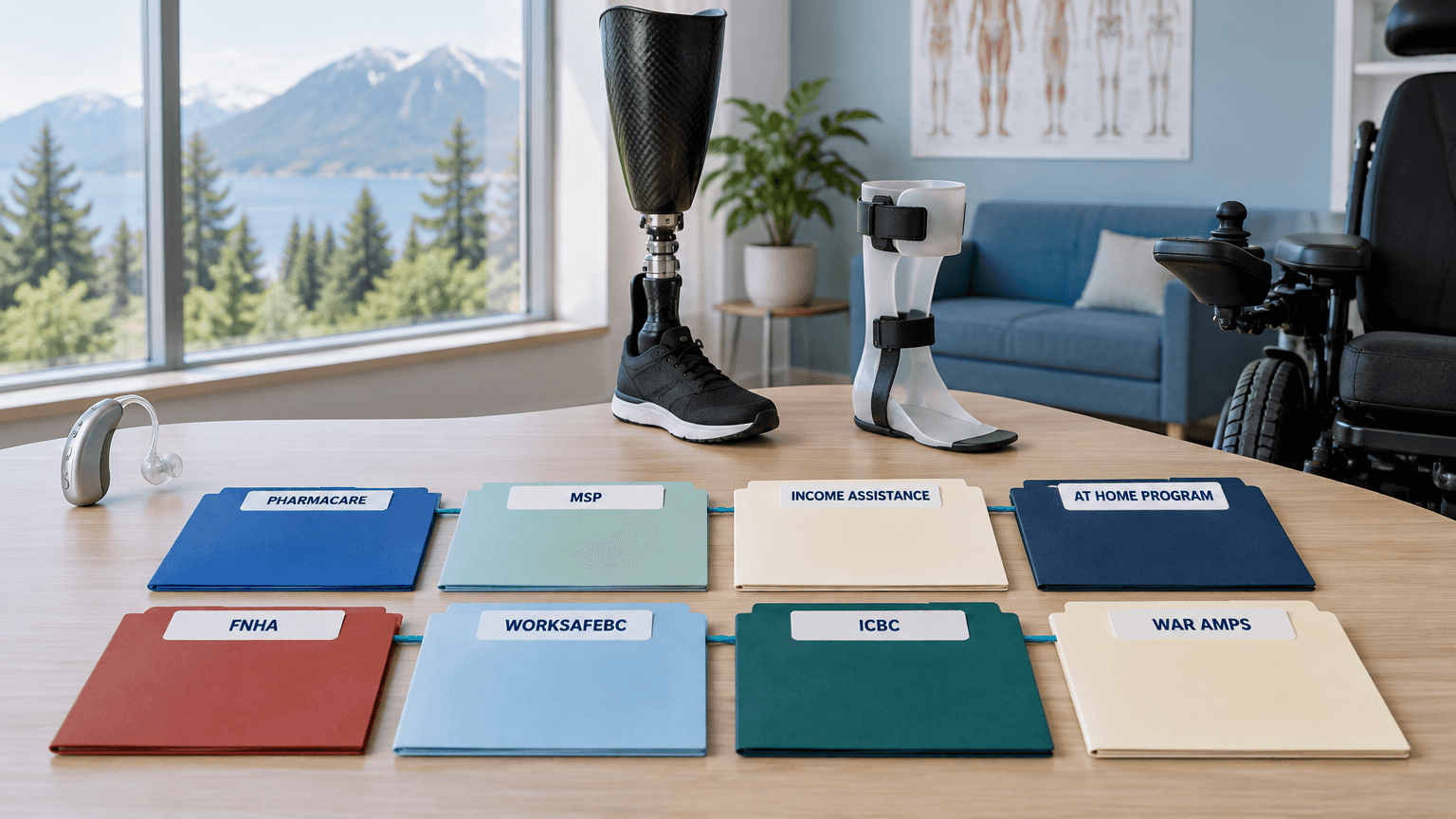
A prosthetic limb, orthotic brace, hearing aid or wheelchair can make everyday life safer and more independent. In British Columbia, working out who pays for that device is often harder than choosing the device itself.
People moving from Ontario, or searching online, often look for a B.C. version of Ontario's Assistive Devices Program. There isn't one. Funding is split across several programs, each with its own rules, and some people qualify for none of them.
This guide explains the main funding options for B.C. residents, especially people with limited income or no private insurance.
Current as of October 7, 2026. Funding rules and amounts can change. Confirm eligibility and obtain approval before ordering a device.
Key takeaways
- B.C. has no ADP. PharmaCare's Prosthetic and Orthotic Program is the closest thing, and it covers a much narrower list.
- MSP does not pay for devices. The Medical Services Plan excludes hearing aids and "other equipment or appliances."
- PharmaCare covers prostheses at any age, but most orthoses only to age 18. Adults' only PharmaCare orthotic benefit is offloading devices for diabetic or neuropathic foot ulcers. Regular foot orthotics and adult braces are not covered.
- Register for Fair PharmaCare before you buy. Your income-based deductible sets what PharmaCare pays, and coverage is not retroactive.
- Income and disability assistance can fill gaps. Eligible recipients may get braces, foot orthotics, hearing aids and mobility equipment from the province, with pre-approval.
- Another payer may come first. PharmaCare does not pay for devices covered by WorkSafeBC, ICBC, Veterans Affairs Canada, FNHA Health Benefits or NIHB.
Is there an Assistive Devices Program in British Columbia?
No. Ontario's Assistive Devices Program (ADP) funds a broad range of long-term equipment regardless of income. B.C. has no equivalent.
Instead, help comes from PharmaCare, the Ministry of Social Development and Poverty Reduction (MSDPR), the At Home Program for children, short-term loan programs, and federal or insurer programs. Each is covered below.
For an adult with no private insurance and no assistance file, a wheelchair, hearing aid or knee brace is often fully out of pocket. Island Health puts it plainly: people living at home in B.C. are responsible for getting their own personal medical equipment unless they are in the BC Palliative Care Benefits Program.
Does MSP cover orthotics, prosthetics, hearing aids or wheelchairs?
No. MSP's list of services not covered includes eyeglasses, hearing aids and other equipment or appliances. MSP pays for medically necessary physician, midwife and diagnostic services, not the devices themselves.
MSP does matter in two indirect ways:
- MSP enrolment is the gateway. Fair PharmaCare, Healthy Kids and the At Home Program all depend on MSP enrolment.
- Supplementary Benefits open other doors. Families with an adjusted net income under $42,000 may qualify for MSP Supplementary Benefits. Their children may then qualify for hearing aids through Healthy Kids.
How does PharmaCare's Prosthetic and Orthotic Program work?
The PharmaCare Prosthetic and Orthotic Program helps pay for basic-function devices that help a person achieve or maintain daily activities.
It covers prostheses at any age, custom orthoses for people 18 or younger, and offloading devices for diabetic and neuropathic foot ulcers.
The provider must be enrolled with PharmaCare. You must have PharmaCare coverage in place before the device is dispensed. Pre-approval is required for devices, and for supplies and services of $400 or more. Approval must arrive before work on the device starts.
Who pays what under each PharmaCare plan?
According to PharmaCare's patient information sheet, people on Plan B (long-term care), Plan C (income assistance) or Plan F (At Home Program) have most eligible devices covered.
Everyone else relies on Fair PharmaCare, which is based on family net income:
- Before the deductible: the family pays eligible costs in full.
- After the deductible: PharmaCare pays 70% (75% if a family member was born before 1940).
- After the family maximum: PharmaCare pays 100% of eligible costs for the rest of the calendar year.
If you never register, or your income cannot be verified, the default deductible is $10,000.
Example. Under the current assistance levels, a family with net income between $48,333 and $51,667 has a $1,500 deductible and a $2,000 family maximum. Its share of PharmaCare-eligible costs for the year cannot exceed $2,000. Prescription costs count toward the same totals.
PharmaCare pays up to its own maximum for each item. Its Full Payment Policy does not apply to these devices, so a provider may charge you any amount above the PharmaCare maximum. PharmaCare also does not fund travel, home or hospital visits, or time spent on assessments and consultations.
British Columbia prosthetic limb funding
PharmaCare covers basic-function prostheses, supplies and services for leg and arm amputations, and for partial foot amputations at the transmetatarsal level or higher.
PharmaCare also covers breast prostheses and lymphedema sleeves after mastectomy or lumpectomy, custom ocular prostheses, and custom ear, nose and orbital prostheses.
It does not cover prostheses that exceed basic function, back-up prostheses, replacements for lost or stolen devices, or prostheses for individual fingers or toes.
A replacement prosthesis is usually covered only if PharmaCare approved the current one at least three years earlier, or two years for a breast prosthesis. Repairs are covered when they extend the device's life and are not under warranty.
Other prosthetic funding programs
The War Amps Child Amputee (CHAMP) Program pays the portion of a child's everyday artificial limb, adjustments and repairs not covered by provincial or private plans. It covers 100% of recreational limbs and devices for children under 18.
The War Amps Adult Amputee Program provides financial assistance toward artificial limbs for enrolled amputees aged 18 and older. Provincial health care and private or workplace insurance must be accessed first.
British Columbia orthotic funding
PharmaCare's orthoses coverage applies to people 18 or younger on Fair PharmaCare, Plan C or Plan F. It covers:
- Permanent leg braces (one orthosis per limb).
- Spinal orthoses for conditions such as spina bifida and scoliosis.
- Plagiocephaly helmets for infants.
It does not cover foot orthoses, orthotic footwear, off-the-shelf products, upper-extremity orthoses, back-up devices, or orthoses needed part-time or for less than a year, such as post-surgical or injury braces. A replacement is usually covered once a year if the orthotist shows the current device no longer meets the child's needs. Coverage ends the day the young person turns 19.
For adults, PharmaCare's only orthotic benefit is offloading devices. These are foot orthoses and adaptive shoes for people with a diabetic or neuropathic foot ulcer. The ulcer must be treated at an approved B.C. clinic or long-term care facility, and the person is referred to a PharmaCare-enrolled orthotist.
Other adults generally pay for braces and foot orthotics privately or through extended health insurance, unless another program below applies.
Can income or disability assistance cover the cost?
Yes, for some people. MSDPR provides health supplements to income assistance and disability assistance recipients who are eligible for general health supplements. Every request must meet these conditions:
- The ministry pre-approves it before purchase.
- No other resource is available, such as PharmaCare, ICBC, WorkSafeBC or private insurance.
- The item is the least expensive appropriate option.
The ministry may co-fund when another payer covers only part of the cost.
Braces and foot orthotics
The MSDPR orthoses policy can cover foot orthotics, orthopaedic footwear, and ankle, knee, hip, upper-extremity and spinal braces. A medical practitioner or nurse practitioner must prescribe the item, and it must be medically essential for basic functionality.
Some items have limits:
| Item | Limit | Replacement period |
|---|---|---|
| Custom foot orthotics (hand-cast mould) | $450 a pair, including assessment | 3 years |
| Custom-made footwear | $1,650, including assessment | 1 year |
| Off-the-shelf orthopaedic footwear | $250 a pair | 1 year |
| Ankle-foot orthosis | — | 2 years |
| Knee brace (worn 6+ hours a day) | — | 4 years |
Custom items must be fitted by a certified orthotist, certified pedorthist, occupational therapist, physical therapist or podiatrist. Prostheses are not part of this benefit. Recipients get prosthetic coverage through PharmaCare Plan C instead.
Mobility equipment
The MSDPR medical equipment policy covers canes, crutches, walkers, manual and power wheelchairs, wheelchair seating, scooters, toileting and transfer aids, hospital beds, pressure relief mattresses and lifts.
A prescription from a medical practitioner or nurse practitioner, or an occupational or physical therapist's assessment, is required. Scooters are capped at $3,500, or $4,500 for a bariatric scooter. Wheelchairs and scooters can usually be replaced after five years, and seating systems after two. Sports wheelchairs, recreational scooters and lift chairs are not eligible.
British Columbia hearing aid funding
B.C. has no general public hearing aid program for adults. MSP excludes hearing aids, and PharmaCare does not list them. Help depends on who you are:
- Income and disability assistance recipients. MSDPR's hearing instruments policy covers up to $2,000 per aid. Aids can be replaced after three years. The hearing provider contacts Pacific Blue Cross for pre-approval, and no doctor's referral is needed.
- Children in lower-income families. The Healthy Kids Program covers the least expensive appropriate hearing aids, bone-anchored aids, cochlear implants and repairs. It is open to children in families eligible for MSP Supplementary Benefits who are not on assistance.
- Babies and young children. The BC Early Hearing Program provides hearing aids, batteries and earmolds at no cost to families when appropriate.
- Children in the At Home Program. The program funds audiology equipment up to $8,000 for all devices combined in a three-year period.
- Injured workers. WorkSafeBC's Hearing Aid Services program covers hearing aids for accepted occupational noise-induced or traumatic hearing loss claims, through contracted providers.
- Veterans, First Nations, Inuit and refugees. See the populations section below.
Ask the clinic to itemize the device, fitting fees, warranty, batteries and future repairs.
British Columbia wheelchair and mobility device funding
Outside income assistance and the programs below, B.C. has no provincial grant for purchasing a wheelchair, scooter or walker. Otherwise, the options are extended health insurance, private payment or charities.
Short-term equipment loans
- The Canadian Red Cross Health Equipment Loan Program lends canes, walkers, wheelchairs, bath chairs, commodes and raised toilet seats on a short-term basis. It works with B.C. health authorities and needs a referral from a physician or health care provider.
- Health authorities run short-term rental programs for people in financial hardship. Island Health's Medical Equipment Provision Program, for example, covers rentals of up to three months. Applicants need MSP coverage, an urgent need and no other funding source. Ask your local home and community care office what is available in your region.
Children and youth
The At Home Program serves children 17 and younger who are dependent in at least three of four daily living activities: eating, dressing, toileting and washing. With pre-approval, it can provide basic wheelchairs and seating, and some orthoses PharmaCare does not cover.
Variety – The Children's Charity of BC offers grants for wheelchairs, walkers, prosthetics and hearing devices for children 19 and under who meet medical and financial criteria.
Funding for specific populations
First Nations
Status First Nations people who live in B.C. receive health benefits from the First Nations Health Authority, not the federal NIHB program. The FNHA Medical Supplies and Equipment benefit, administered by Pacific Blue Cross, covers prosthetics, braces and splints, foot orthotics and orthopedic shoes, hearing aids and repairs, and walking aids and wheelchairs.
Some items need prior approval. Scooters are excluded because a covered alternative exists. Infants up to 24 months are covered if at least one parent is eligible. PharmaCare will not pay for P&O devices that FNHA Health Benefits covers.
Inuit
Inuit living in B.C. are covered by the federal Non-Insured Health Benefits program. Its medical supplies and equipment benefit lists include audiology, orthotics, prosthetics and mobility equipment.
Refugees and protected persons
The Interim Federal Health Program covers 70% of eligible supplemental benefits, including prosthetics, mobility aids and hearing aids. The patient pays a 30% co-payment. The provider must be registered with the IFHP.
Veterans
Veterans Affairs Canada treatment benefits include hearing services, prosthetics and orthotics, wheelchairs and walking aids, and special equipment, depending on the veteran's eligibility.
People injured at work
WorkSafeBC pays for prosthetic and orthotic services on accepted claims. Since July 1, 2024, orthotic providers must hold a WorkSafeBC contract to treat injured workers. Prosthetic services use a pre-authorization form.
People injured in a vehicle crash
For people injured on or after May 1, 2021, ICBC has been the first payer for covered prostheses, orthoses and medical equipment since May 1, 2025. Submit receipts within 180 days of the expense.
How to apply for assistive device funding in British Columbia
- Identify the primary payer. Check WorkSafeBC, ICBC, Veterans Affairs, FNHA or NIHB before PharmaCare or the ministry.
- Register for Fair PharmaCare early. Do it before any device is dispensed, and return the income-verification consent form within 30 days.
- Use an enrolled or contracted provider. PharmaCare, WorkSafeBC and IFHP only pay registered providers.
- Get an itemized quote. Separate the program maximum, your deductible or co-payment, and any amount above the maximum.
- Wait for written pre-approval. PharmaCare and the ministry will not pay for work started or items bought before approval. Ask any charity about its rules first.
- Keep records. Save prescriptions, quotes, approvals and denials, and ask about reconsideration if a request is refused.
Frequently asked questions about British Columbia assistive device funding
Is there an assistive devices program in B.C. like Ontario's ADP?
No. PharmaCare covers prostheses, children's custom orthoses and diabetic offloading devices. Other devices depend on income assistance, the At Home Program, an insurer or a federal program.
Does MSP cover orthotics?
No. MSP excludes equipment and appliances. PharmaCare covers custom orthoses only for people 18 and under, plus offloading devices for diabetic and neuropathic foot ulcers at any age. Adults on income or disability assistance may get foot orthotics or braces through MSDPR.
Does PharmaCare cover the full cost of a prosthetic leg?
Not always. Under Fair PharmaCare, you pay eligible costs until your deductible is met, then 30% until your family maximum. The provider may also charge above PharmaCare's maximum. Plans B, C and F cover most eligible devices.
How can I get financial help for a prosthetic leg if PharmaCare leaves a balance?
First rule out a primary payer such as WorkSafeBC, ICBC or Veterans Affairs. After provincial and private coverage have been used, The War Amps Adult and Child Amputee Programs can help with the remaining cost.
Does B.C. pay for hearing aids for adults?
Only for certain groups: income and disability assistance recipients (up to $2,000 per aid), injured workers with an accepted claim, veterans, FNHA and NIHB clients, and IFHP clients. Other adults generally pay privately or through extended health insurance.
Can I buy the device first and apply afterward?
Usually no. PharmaCare does not cover work started before approval, and Fair PharmaCare does not cover retroactive claims. The ministry will not pay for items bought without prior approval, except in a life-threatening emergency.
Where can I find local funding help?
Hospital and rehabilitation social workers often know about local foundations. bc211 lists community services across the province, including disability and assistive technology resources.
The key is to coordinate funding before purchase
B.C. does offer real support for prosthetics, orthotics, hearing aids and mobility equipment. That support is narrower than many people expect, and it is spread across separate programs with different rules.
The safest approach is to identify the primary payer, register for Fair PharmaCare early, and obtain written pre-approval before anything is ordered. A coordinated plan can prevent missed benefits and reduce what a patient pays.
For clinics, keeping the prescription, approvals, estimate and invoices for each payer connected makes this easier to follow. Medfair keeps patient files, scheduling, claims and billing in one system.
Comparing provinces? Read our funding guides for Alberta, Saskatchewan, Manitoba, Ontario and Quebec.
Sources
- MSP: Services not covered
- MSP Supplementary Benefits
- PharmaCare Prosthetic and Orthotic Policy Manual
- PharmaCare Prosthetic and Orthotic Program information sheet (PDF)
- Prostheses covered by BC PharmaCare
- Orthoses covered by BC PharmaCare
- Offloading devices covered by BC PharmaCare
- PharmaCare devices and supplies coverage
- Fair PharmaCare plan
- Fair PharmaCare assistance levels
- BCEA policy: Medical Equipment and Devices
- BCEA policy: Medical Equipment – Orthoses
- BCEA policy: Medical Equipment – Hearing Instruments
- BCEA policy: Healthy Kids
- At Home Program
- At Home Program Guide (PDF)
- BC Early Hearing Program
- HealthLink BC: Health Equipment Loan Program
- Island Health: Medical Equipment Provision Program
- FNHA Medical Supplies and Equipment benefit
- NIHB eligibility
- NIHB Medical Supplies and Equipment benefit lists
- Interim Federal Health Program coverage summary
- Veterans Affairs Canada: Programs of Choice
- WorkSafeBC: Hearing Aid Services
- WorkSafeBC: Prosthetics
- WorkSafeBC: Orthotic services
- B.C. government: ICBC accident benefit changes (2025)
- ICBC: Overview of the injury claims and recovery process
- The War Amps: Child Amputee Program
- The War Amps: Adult Amputee Program
- HealthLink BC: Variety – Apply for a Grant
- bc211