

Bill S-5: What it means for allied health clinics
Canada’s proposed Connected Care for Canadians Act would put new interoperability and data-portability duties on health technology vendors. For small clinics, the practical test is simple: can your information move when your care or your software does?
Aalim Rattansi
September 30, 2026
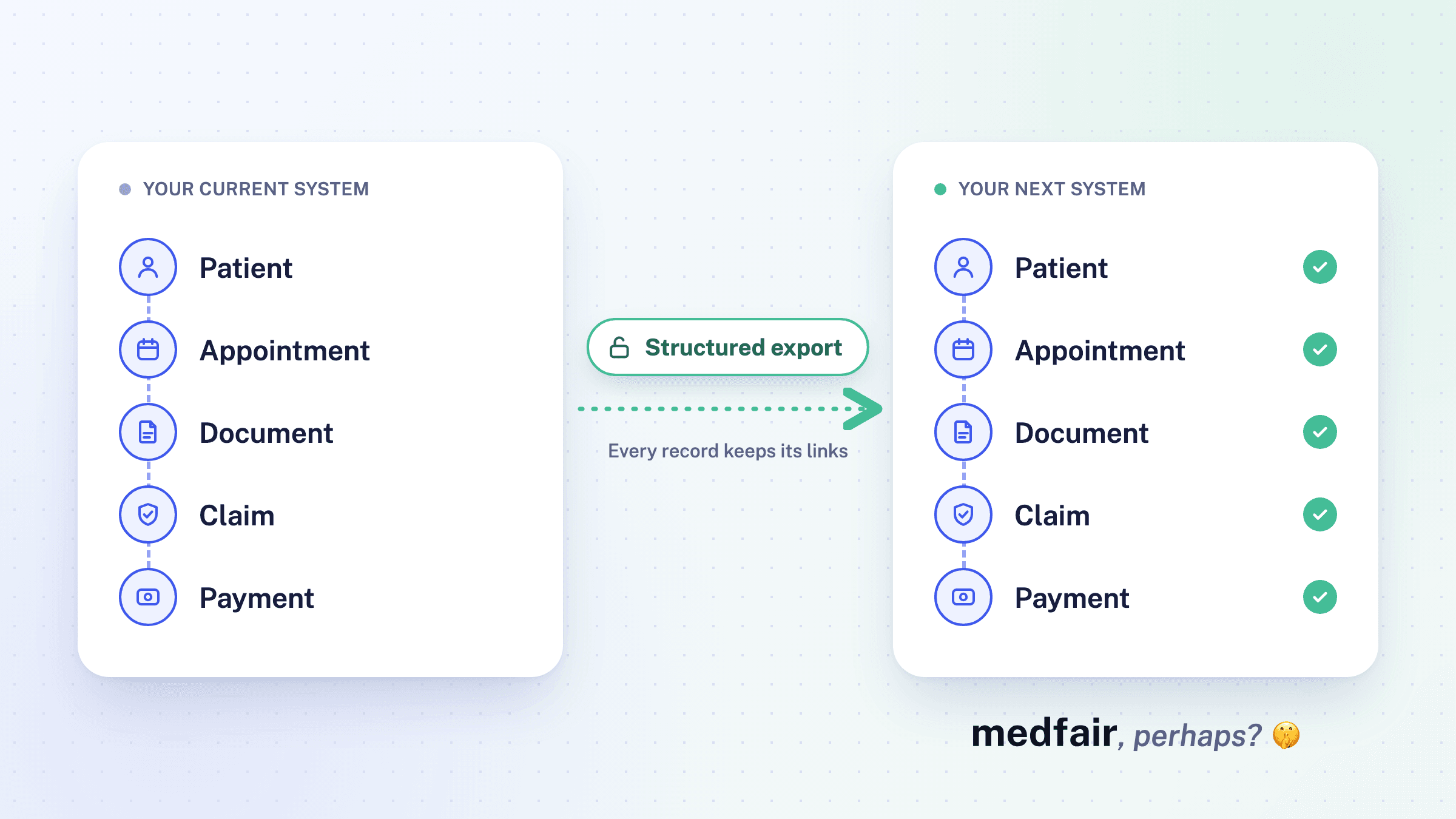
A clinic should not have to choose between keeping its software and keeping practical access to its own information.
Yet that is what vendor lock-in can feel like. A clinic decides to change systems and discovers that its patient records arrive as hundreds of PDFs. Appointment history is separated from clinical notes. Claim statuses and funding details do not come across at all. The export takes weeks, requires a large fee or cannot be imported into the new platform without re-keying years of work.
For a small allied health clinic, that is not an abstract technology problem. It can mean delayed claims, missed follow-ups, incomplete patient histories and staff spending evenings reconstructing records.
Bill S-5, the proposed Connected Care for Canadians Act, is meant to change the incentives behind that problem. It would require health information technology vendors to make their systems interoperable and would prohibit “data blocking”: practices that prevent, discourage or interfere with access to, use of or exchange of electronic health information.
The public conversation has focused largely on hospitals, physicians and provincial health systems. But the principle matters just as much in orthotics and prosthetics, hearing, mobility, rehabilitation and other allied health settings.
If patient information is necessary to deliver care, run a clinic or complete a claim, the clinic should be able to retrieve it securely and move it in a useful form.
Key takeaways
- Bill S-5 is not law yet. As of September 29, 2026, it has passed the Senate and is waiting for second reading in the House of Commons.
- The bill is aimed at vendors. It would require health technology to support easy, complete and secure access, use and exchange of electronic health information.
- “Data blocking” is broader than refusing an export. Delays, unreasonable restrictions, unusable formats and excessive fees may all frustrate the movement of information.
- Many details will come later. Technical standards, regulated practices, exceptions, complaints and penalty amounts would be set through regulations.
- Clinics do not need to wait to ask better questions. Export format, cost, timing, completeness and migration support should be part of every software decision now.
What Bill S-5 would do
The bill passed by the Senate sets out two core obligations for health information technology vendors.
First, a vendor would have to ensure that the technology it licenses, sells or supplies as a service is interoperable. Under the bill, that means a user can easily, completely and securely access and use all electronic health information and exchange it with other health technologies, unless a privacy law prohibits it. The technology would also have to meet standards and specifications established in future regulations.
Second, the bill would prohibit data blocking by a vendor. Its definition is broad: a practice or act that prevents, discourages or interferes with access to, use of or exchange of electronic health information, including any practices the regulations specify.
The legislation would also allow regulations to create a complaints process and administrative monetary penalties for non-compliance.
That does not mean every frustrating export would automatically break the law. The regulations would still need to define many of the rules. The Act would also apply in a province or territory only after the federal cabinet makes an order for that jurisdiction, and it could do so only if it is satisfied that the province or territory does not already have substantially similar or stronger requirements.
It also does not create a national health-record database, and the bill’s interoperability duty gives way to any privacy law that prohibits the access or exchange. As Health Canada explains, the Act is not creating a digital ID, platform or database of health information, and it enables, rather than compels, secure access and sharing.
The direction, however, is clear: health software should help information follow the patient instead of turning each system into a dead end.
What data blocking looks like in a small clinic
Data blocking can sound like a deliberate refusal: a vendor simply saying no. In practice, the barrier may be less obvious.
The export exists, but no one can use it
A vendor may provide a collection of PDFs or images that a person can read but another system cannot reliably import. The clinic technically received its records, yet staff still have to recreate patient demographics, appointments, notes, device history and claim details one field at a time.
A useful export preserves structure. It should be possible to tell which patient, appointment, document, claim and payment each record belongs to.
Leaving costs more than staying
Data work has a real cost, and some migrations require specialized support. The warning sign is a fee or restriction that makes access impractical, especially when the clinic is trying to obtain information it has already entered and maintained.
The Canadian Medical Association’s explanation of Bill S-5 points to long waits, unreadable data dumps and excessive fees as examples of how data can remain effectively siloed.
The most important history does not make the trip
A basic patient list is not a complete clinical or operational record.
For an allied health clinic, continuity may depend on device history, prescriptions, authorizer information, attachments, consent records, appointment notes, ADP or other funding details, claim status, patient balances and an audit trail. If those relationships disappear during migration, the clinic can lose the context it needs to care for the patient and reconcile the work.
Information can leave, but it cannot connect
Portability is the ability to take information out. Interoperability goes further: information can be exchanged and used across systems.
That distinction matters when a patient moves between a family doctor, an allied health provider, a hospital, a funder and a device supplier. An exported file sitting on someone’s desktop does not create connected care. The information has to arrive securely, with enough structure and context to support the next decision.
Why allied health clinics should pay attention
Small clinics often feel switching costs more sharply than large health systems.
There may be no internal IT team to clean a dataset, map fields or test a migration. The same people responsible for patient care, scheduling and claims are also responsible for validating thousands of records. If something is missing, they are the ones who find it after go-live.
Allied health records can also cross several kinds of work. A single patient journey may include an assessment, a prescription, a device order, funding approval, fabrication, fitting, payment and follow-up. When software stores those steps in separate modules—or when a new system imports only some of them—the patient file loses its story.
That is why data portability should not be treated as an exit problem. It is a continuity-of-care and continuity-of-operations problem.
A clinic with reliable access to its information can change vendors with less disruption, respond to patient-access requests, maintain records for the required period, recover from a service failure and connect new tools without rebuilding its history from scratch.
Questions to ask every software vendor
Bill S-5 still has to move through the House of Commons, and much of its practical effect would depend on future regulations. Clinics can still use its direction as a procurement standard today.
Before signing or renewing a software agreement, ask:
- What can we export? Confirm whether the export includes patients, notes, appointments, documents, claims, funding details, payments, communications and audit history—not only contact information.
- What format will we receive? Ask which information comes in structured, machine-readable files and which items come as documents or images.
- How long will it take? Get a defined process and turnaround time for routine exports, a full migration and an urgent request.
- What will it cost? Separate reasonable migration services from charges that make accessing or leaving with your information impractical.
- What happens after termination? Confirm how long access remains available, when information is deleted and whether the clinic can verify that its final export is complete.
- Who helps with migration? An export is only the first half of a move. Ask how fields are mapped, attachments are matched, duplicates are handled and record counts are reconciled.
- How is privacy protected? Confirm how the vendor authenticates requests, transfers files securely, limits access and records the exchange.
The best time to learn the answers is before the clinic depends on the system.
Where Bill S-5 stands
Bill S-5 is further along than its predecessor, Bill C-72, which was introduced in June 2024 but passed only first reading before Parliament was prorogued and a federal election was called.
The bill was introduced in the Senate on February 4, 2026. The Senate passed it on May 26, and the House of Commons gave it first reading on May 28. As of September 29, LEGISinfo lists it as “at second reading in the House of Commons,” but no second-reading debate has been recorded there yet. It has not become law.
Even if Parliament passes it, implementation will not be immediate or identical everywhere. The Act would come into force on a date set by the federal cabinet. Regulations would establish technical requirements and enforcement details. Its application in each province or territory would also depend on whether that jurisdiction already has substantially similar or stronger rules.
For clinics, that is a reason to be precise—not a reason to ignore the bill. The legislation is a strong signal about where health technology policy is heading: common standards, secure exchange and less tolerance for business models that depend on trapped information.
Portability should be ordinary
A clinic should be able to adopt better software because it improves care and operations, not avoid a change because its history has been made too painful to move.
At Medfair, we are building for that expectation. Clinics can request a full CSV export of their data on any plan (see pricing), and we support clinics that need help importing information from a system they are leaving. Portability is not a favour at the end of a contract. It is part of respecting the clinic that trusted us with its work.
Bill S-5 may change the formal obligations placed on health technology vendors. The more important shift is already underway.
Clinics are beginning to expect that their systems can connect. Patients are beginning to expect that their information can follow them. Vendors should be prepared to earn trust without relying on the cost of leaving.
Frequently asked questions about Bill S-5
What is Bill S-5?
Bill S-5 is the Connected Care for Canadians Act, a federal bill introduced in the Senate on February 4, 2026. It would require health information technology vendors to make their technology interoperable and would prohibit data blocking. Regulations would set the technical standards and could create a complaints process and administrative monetary penalties.
What is data blocking?
The bill defines data blocking as a practice or act that prevents, discourages or interferes with access to, or the use or exchange of, electronic health information. Regulations can specify further practices. The Canadian Medical Association says data blocking can show up as long waits, unreadable data dumps or excessive fees.
Is Bill S-5 law yet?
No. The Senate passed it on May 26, 2026, and the House of Commons gave it first reading on May 28. As of September 29, 2026, LEGISinfo lists it as at second reading in the House, with no second-reading debate recorded yet. If Parliament passes it, it would come into force on a day set by the federal cabinet.
Does Bill S-5 apply to my clinic?
Its two core duties, interoperability and the ban on data blocking, fall on health information technology vendors rather than on clinics. The definition of health information technology is broad: hardware and software designed for creating, maintaining, accessing, using or exchanging electronic health information. The Act would also apply in a province or territory only after a federal order for that jurisdiction. Confirm specifics with your vendor and a legal advisor.
How is Bill S-5 different from Bill C-72?
The CMA describes S-5 as nearly identical to Bill C-72, which was introduced in June 2024 and passed only first reading before Parliament was prorogued and a federal election was called. S-5 has already passed the Senate.
What should a clinic ask its software vendor about exporting data?
Ask what can be exported (patients, notes, appointments, documents, claims, funding details, payments, communications and audit history), in what format, how long it takes, what it costs, what happens after termination, who helps with migration and how privacy is protected.
Sources
- Bill S-5 status — LEGISinfo, Parliament of Canada
- Bill S-5 as passed by the Senate — Parliament of Canada
- Health Canada — The Government of Canada introduces legislation to build a more connected health care system
- Canadian Medical Association — Putting health care on the agenda: What to watch as Parliament returns