
Ontario’s $325M primary care push: what it signals for allied health providers
Ontario is funding primary care teams at scale. For allied health providers, the opportunity is real—but it will flow through local partnerships, measurable capacity and connected workflows.
Aalim Rattansi
September 17, 2026
The most important word in Ontario’s latest primary care announcement is not “million.”
It is “team.”
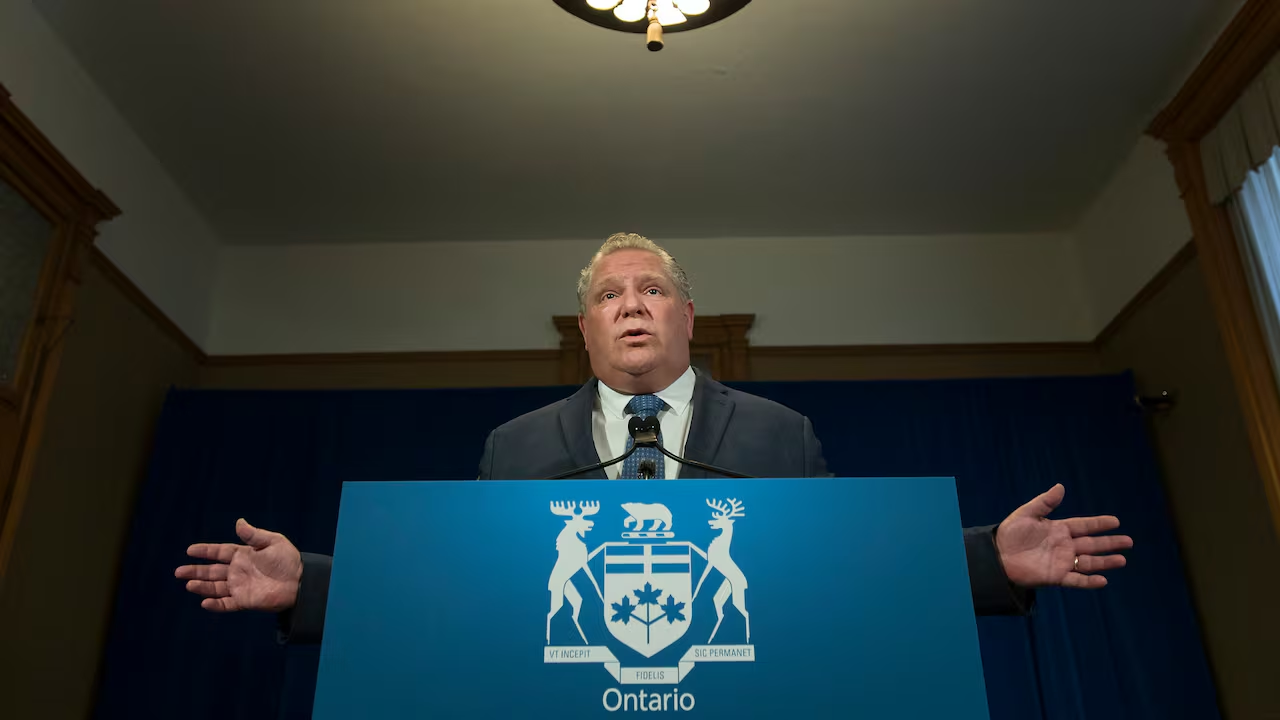
Through its 2026 Budget primary care update, Ontario is adding $325 million to its Primary Care Action Plan. That brings the four-year commitment to $3.4 billion, with the goal of connecting every person in the province to a family doctor or primary care team by 2029.
The province plans to create or expand 305 teams and attach roughly two million people to ongoing primary care over four years.
This is usually described as an access-to-a-family-doctor story. It is that. But it is also a workforce story, a clinic design story, and a signal that Ontario expects more care to happen through interprofessional teams.
For allied health providers, that distinction matters.
Key takeaways
- The money: Budget 2026 adds $325 million to Ontario’s Primary Care Action Plan, bringing the four-year investment to $3.4 billion.
- The goal: connect everyone in Ontario to a family doctor or primary care team by 2029, by creating or expanding 305 teams for about two million people.
- The route: the funding goes to interprofessional primary care teams, with proposals developed through local Ontario Health Teams and their Primary Care Networks. It is not a blanket expansion of public reimbursement for independent practices.
- The opening: allied providers who bring a defined patient population, full-scope practice, measurable capacity and connected workflows will be the easiest for those teams to bring in.
Primary care in Ontario is becoming a team sport
A family doctor or nurse practitioner may remain the front door to primary care. They cannot be every room in the house.
A patient with diabetes may need medication management, nutrition support and foot care. An older adult at risk of falling may need a medication review, mobility assessment and help adapting their home. A person living with chronic pain may need mental-health support and rehabilitation alongside medical treatment.
Those needs do not arrive one at a time. They overlap.
Ontario’s current model increasingly recognizes that. The province describes interprofessional primary care teams as groups that can include family physicians, nurse practitioners, nurses, physician assistants, physiotherapists, social workers, dietitians, midwives and pharmacists, all working to their full scope of practice. Existing Family Health Teams may also include professionals such as psychologists, respiratory therapists, occupational therapists and chiropodists, depending on local need.
That list is not just a description of who may work in the building. It reflects a different idea of primary care: one in which the right provider does the right work, and the patient does not have to assemble the team alone.
What the $325 million does—and does not—mean
The funding creates a real opening for allied providers. It is not a blanket expansion of public reimbursement for every independent practice.
Ontario’s recent calls for proposals have been organized around new and expanded primary care teams. For the 2026–27 call for proposals, proposals were generally coordinated and submitted through local Ontario Health Teams and Primary Care Networks, with a separate pathway for Indigenous-led proposals. The province says more than $250 million in that cycle will support teams expected to connect another 500,000 people to care.
In other words, the opportunity is likely to flow through organizations, partnerships and local care plans—not through thousands of disconnected applications from individual providers.
That changes the question allied clinics should ask.
Not: “How do we get a piece of the funding?”
But: “What gap can we help a local primary care team close?”
The opportunity is bigger than referrals
Allied providers have always received referrals from primary care. Team-based care asks for more than a referral relationship.
A referral can still leave the patient carrying information between offices, repeating their history and waiting while providers exchange faxes. An integrated care pathway creates shared expectations: who sees the patient, how quickly, what information travels with them, when care returns to the primary clinician, and what happens if the patient’s condition changes.
That is a much more valuable role.
For a pharmacist, it could mean a defined medication-management pathway for patients with multiple chronic conditions. For a social worker, it could mean embedded mental-health and system-navigation support. For a dietitian, it could mean a shared diabetes program with measurable follow-up. For physiotherapists and occupational therapists, it could mean earlier intervention around mobility, pain, falls and functional independence.
The discipline matters. The operating model matters more.
What interprofessional primary care teams will need from allied providers
The funding is tied to a clear public objective: attach more people to ongoing care. Allied providers that can show how they increase a team’s capacity will be easier to integrate than those offering a menu of services without a defined system role.
Four capabilities will matter.
1. A clear patient population
“Physiotherapy” is a profession. “Rapid assessment and treatment for older adults at risk of falling” is a service model.
Teams will need partners who can define who they serve, what problem they solve, how patients enter the service and when they return to primary care.
2. Full-scope practice
Ontario’s plan explicitly calls for health professionals to work to their full scope. That is partly about workforce supply. It is also about removing avoidable handoffs and using scarce clinical time well.
Allied providers should be ready to explain which parts of a patient journey they can safely own—not only where they can assist.
3. Measurable capacity
Publicly funded teams will be expected to report on access, attachment and performance. A strong allied-care proposal should be able to answer practical questions:
- How many patients can you see?
- How quickly can you see them?
- Which outcomes will you track?
- How will your service reduce pressure elsewhere in the team?
- Can the model work in rural, remote or underserved communities?
A good idea becomes fundable when it becomes measurable.
4. Connected operations
Team-based care depends on information moving with the patient.
Ontario is also advancing a provincewide primary care medical record and promising better digital referrals, patient navigation and access to health information. The federal government’s VITAL investment is focused on hospital data and research rather than day-to-day primary care, but it points in the same direction: less fragmentation, stronger governance and more useful health data.
For an allied provider, digital readiness is no longer an administrative detail. It means privacy-conscious documentation, reliable referral intake, timely notes back to the team, clear consent practices and workflows that do not create another silo. (We wrote about what that looks like inside a clinic in Why Medfair Is Right for Your Clinic.)
Where independent allied health clinics fit
Not every allied provider will become an employee of a Family Health Team. Nor should they.
Some teams will hire directly. Others may use service agreements, sessional arrangements, shared programs or formal referral pathways with community partners. The right structure will depend on the local population, the profession and the team’s existing capacity.
For independent clinics, the practical first step is local.
Find your Ontario Health Team. Learn how its Primary Care Network is organized. Look at the population it serves and the gaps it has named. Then bring forward one concrete pathway—not a general pitch.
That pathway should describe:
- the patients it is designed for
- the service and expected turnaround time
- the roles of the allied provider and primary care team
- the information that must be shared
- the capacity and outcomes the model can report
- the proposed funding and governance arrangement
Start narrow enough to measure. Build trust. Expand from evidence.
The signal behind the spending
The $325 million will not solve every primary care problem. Team growth still depends on recruitment, retention, space, governance, digital infrastructure and enough clinicians to lead longitudinal care.
But the direction is clear.
Ontario is not only buying more appointments. It is building more capacity around primary care clinicians. That makes allied health less peripheral to the system’s access strategy and more central to how the strategy works.
The opportunity for allied providers is not simply “more referrals.”
It is a chance to become part of primary care’s operating model: connected to the team, accountable for a defined part of the patient journey, and trusted to work at full scope.
The clinics and providers that prepare for that role now will be much easier to bring into the teams Ontario is funding next.
Frequently asked questions
How much is Ontario investing in primary care in 2026?
Ontario’s 2026 Budget adds $325 million to the Primary Care Action Plan. Combined with ongoing funding, that brings the plan’s four-year investment to $3.4 billion, with the goal of connecting everyone in Ontario to a family doctor or primary care team by 2029.
What is an interprofessional primary care team?
A group of health professionals who provide ongoing primary care together, each working to their full scope of practice. In Ontario, a team can include family physicians, nurse practitioners, nurses, physician assistants, physiotherapists, social workers, dietitians, midwives and pharmacists. Family Health Teams may also include psychologists, respiratory therapists, occupational therapists and chiropodists.
Can an independent allied health clinic apply for this funding directly?
Not on its own. The 2026–27 call for proposals funds only approved team models: Family Health Teams, Community Health Centres, Nurse Practitioner-Led Clinics and Indigenous Primary Health Care Organizations. Proposals are developed with local Ontario Health Teams and their Primary Care Networks, and Indigenous organizations may apply directly. The ministry does encourage funded teams to collaborate with community partners.
How can an allied health clinic work with an Ontario primary care team?
Start with your local Ontario Health Team. Learn how its Primary Care Network is organized and which gaps it has named, then propose one concrete pathway: who it serves, how quickly, what information is shared, and which outcomes you will report. Depending on the team, that pathway might become a hiring arrangement, a service agreement, a sessional role or a formal referral pathway.
Sources
- Ontario’s Primary Care Action Plan: next steps in Budget 2026
- Call for proposals for Interprofessional Primary Care Teams
- Frequently Asked Questions: 2026–27 Call for Proposals for New and Expanded Primary Care Teams
- Family Health Teams in Ontario
- Ontario Health Teams
- 2025–2026 Minister of Health’s Primary Care Act Annual Report
- Government of Canada investment in the VITAL health data platform